
Securing Industrial Systems Through IDS-Driven Patch Intelligence

Cyber security admin todayJuly 25, 2026

Background
share close

In today’s interconnected world, Operational Technology (OT) systems are under growing pressure from both cyber adversaries and regulators. From Programmable Logic Controllers (PLCs) in refineries to Distributed Control Systems (DCS) in power plants, these devices form the backbone of industrial operations. Unlike IT systems, they cannot be casually rebooted or patched on a Tuesday afternoon. They control critical infrastructure where even a brief outage can result in production losses, safety incidents, or regulatory violations.

At the same time, threat actors are increasingly targeting vulnerabilities in industrial devices. Nation-state campaigns, ransomware operators, and hacktivists have all been observed exploiting unpatched firmware in ICS/SCADA systems, HMIs, engineering workstations, and industrial firewalls. The result is a high-stakes balancing act: organizations must keep systems patched to protect against exploitation, yet patching itself may introduce downtime, instability, or operational risks.


This is where REPLIL Unified Patch Management (UPM) steps in. Designed specifically for OT environments, REPLIL combines vendor-validated patching workflows with Intrusion Detection System (IDS) integration, aligning every patch decision with real-world threat activity and global compliance frameworks such as IEC 62443, NIST SP 800-82, and NCA OTCC. The result is a closed-loop system that doesn’t just deploy patches — it ensures they are prioritized, validated, and auditable.

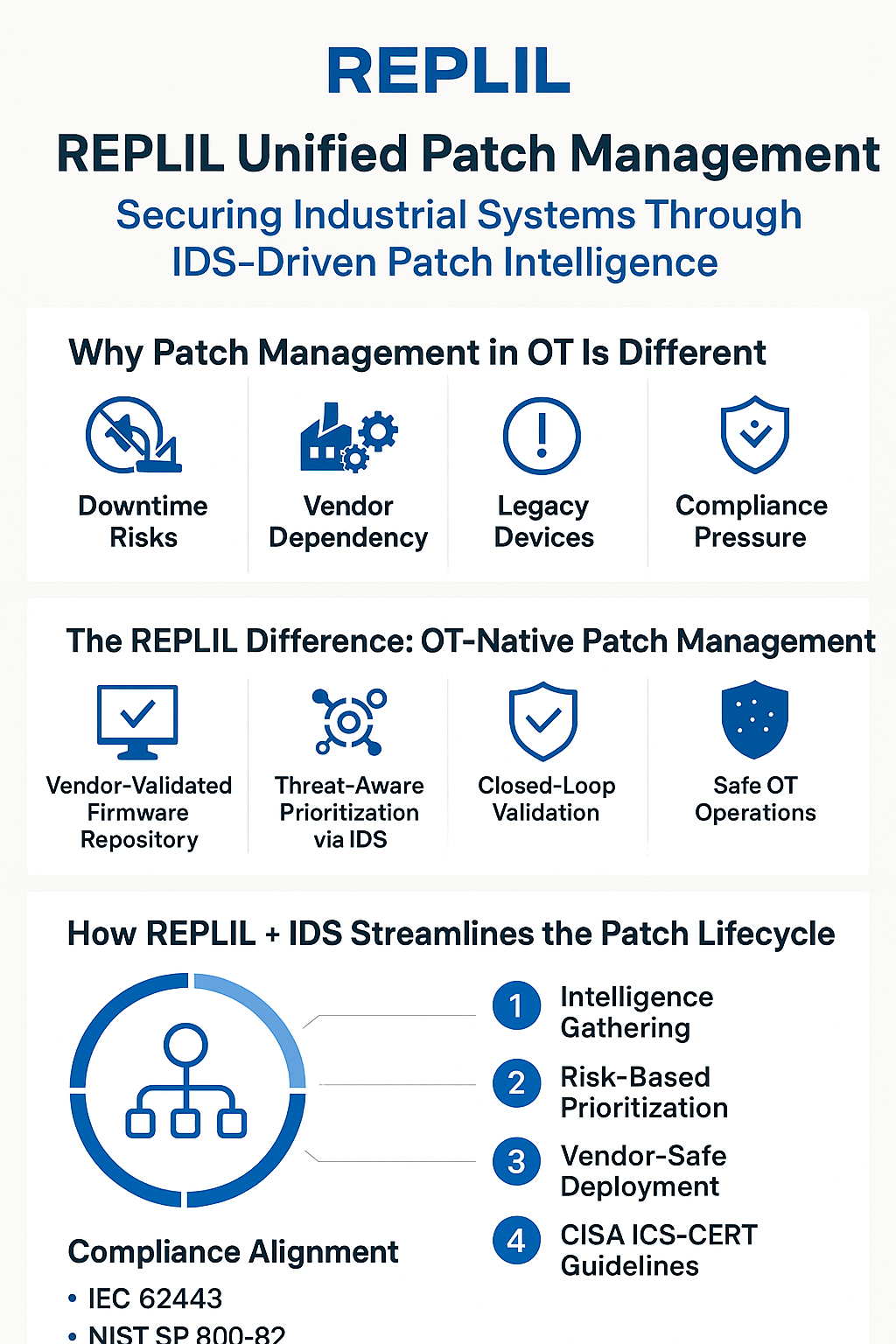
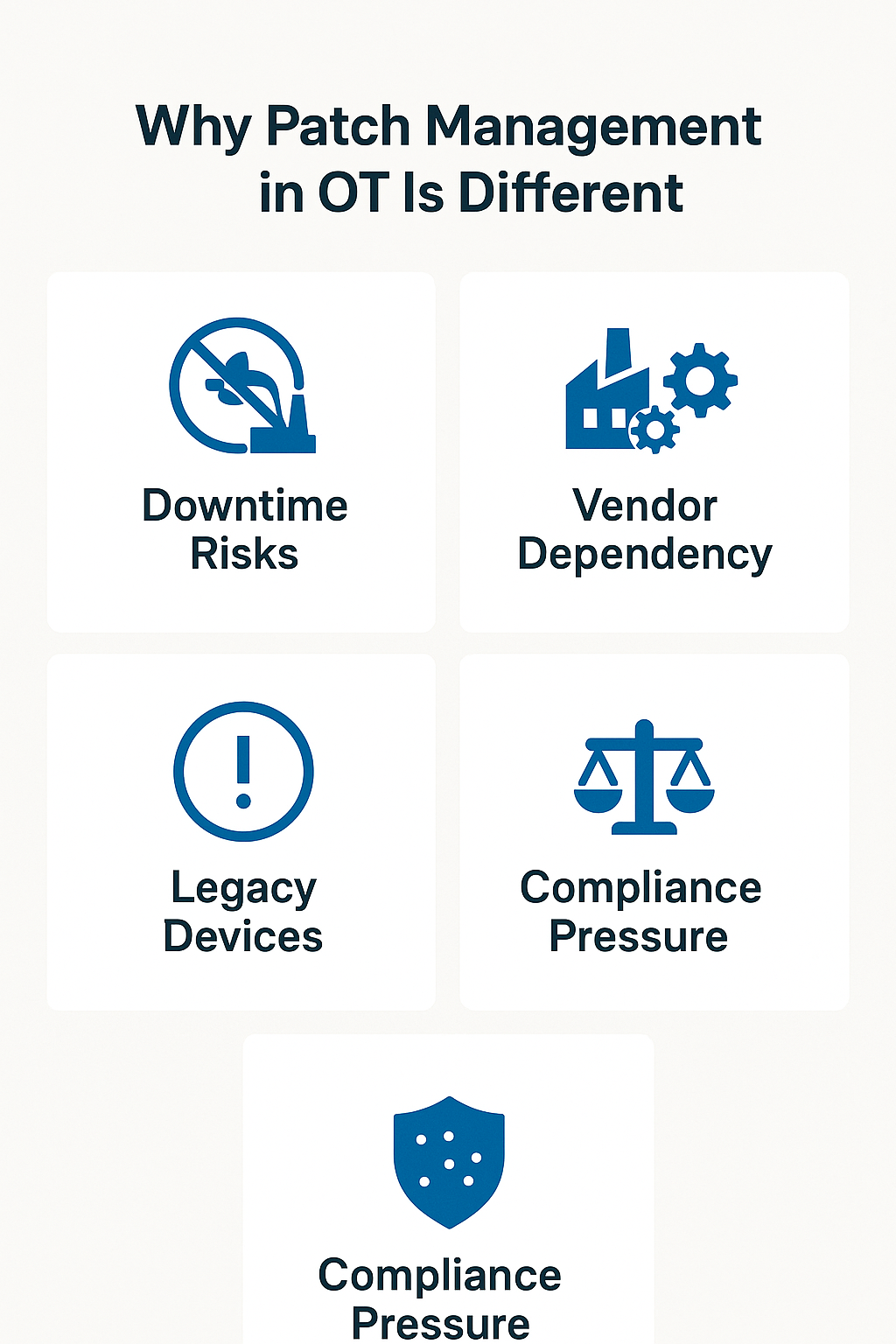
Why Patch Management in OT Is Different

Traditional IT patching tools were built for desktops, servers, and business applications. While effective in office environments, they fall short when applied to OT systems because:

  1. Downtime Risks
    OT systems run continuous processes in oil & gas plants, utilities, and manufacturing lines. Applying a patch without thorough planning could mean halting production or introducing a safety hazard.

  2. Vendor Dependency
    Unlike IT, where patches are pushed directly from Microsoft or Linux distros, OT firmware updates must be validated by vendors such as Siemens, Schneider, Yokogawa, ABB, or Rockwell. Only vendor-approved patches can be deployed to critical controllers.

  3. Legacy Devices
    Many ICS devices operate on unsupported operating systems or outdated firmware. Some cannot be patched at all, requiring compensating controls such as segmentation, monitoring, or IDS signatures.

  4. Compliance Pressure
    Regulations and standards (IEC 62443, NIST, NCA OTCC, CISA ICS-CERT) mandate structured patch management, complete with risk assessments, vendor validation, and audit evidence.

For these reasons, a “just push updates” IT patching model is neither safe nor compliant in OT. A specialized solution like REPLIL is essential.

The REPLIL Difference: OT-Native Patch Management

REPLIL Unified Patch Management was architected with OT realities at its core. Unlike IT-first tools that try to bolt on OT features, REPLIL starts with industrial systems and extends outward to cover IT assets where relevant. Its key pillars are:

1. Vendor-Validated Firmware Repository

  • REPLIL curates a repository of vendor-certified patches and firmware from ABB, Siemens, Schneider-Foxboro, GE, Yokogawa, Rockwell, and others.

  • Each package is cross-checked against device model, version, and architecture to ensure safety before deployment.

  • This reduces risk of incompatibility or downtime — a critical factor in ICS.

2. Threat-Aware Prioritization via IDS

  • REPLIL integrates with IDS solutions (Tenable OT, Suricata, Snort, and proprietary OT IDS platforms).

  • Vulnerabilities aren’t prioritized by CVSS score alone, but by real-time attack data from the plant network.

  • For example, if IDS detects Modbus exploit attempts against an unpatched PLC, REPLIL automatically elevates that patch to high priority.

3. Closed-Loop Validation

  • After patches or firmware updates are applied, IDS continues to monitor for attempted exploitation.

  • If malicious activity disappears, the patch is validated as effective.

  • If exploitation persists, REPLIL flags misconfiguration or incomplete deployment for remediation.

4. Safe OT Operations

  • When downtime prevents immediate patching, REPLIL uses IDS alerts to recommend compensating controls such as firewall rules, segmentation, or enhanced monitoring.

  • This ensures protection even for unpatchable or legacy assets.

How REPLIL + IDS Streamlines the Patch Lifecycle

Step 1: Intelligence Gathering

  • REPLIL ingests vendor patch bulletins, CVE databases, ICS-CERT advisories, and compliance requirements.

  • IDS supplies real-time insights on which vulnerabilities are actually under attack in the OT environment.

Step 2: Risk-Based Prioritization

  • Patches are ranked not just by severity, but by threat activity and asset criticality.

  • Safety-critical controllers or gateways under attack move to the top of the patch queue.

Step 3: Vendor-Safe Deployment

  • Patches are tested in REPLIL’s sandbox lab or validated against vendor documentation before release.

  • Downtime scheduling is planned in line with production cycles.

Step 4: Validation & Monitoring

  • IDS monitors the environment post-deployment to confirm exploit attempts fail.

  • Any lingering attack traffic triggers alerts for additional remediation.

Step 5: Compliance Reporting

  • REPLIL automatically generates audit-ready reports showing:

    • Which vulnerabilities were patched.

    • Which remain pending.

    • Which compensating controls are in place.

  • These reports map directly to standards like IEC 62443-2-3, NIST SP 800-82, and NCA OTCC.

Compliance Alignment

Compliance is not an afterthought in OT — it is often the driver of patch programs. REPLIL aligns seamlessly with major frameworks:

  • IEC 62443-2-3 – Defines patch and vulnerability management for IACS environments. REPLIL automates collection, validation, and deployment of vendor patches while maintaining audit logs.

  • IEC 62443-4-2 – Requires secure product lifecycle practices. REPLIL ensures vendor-validated patches only are used for controllers and firmware.

  • NIST SP 800-82 – Provides ICS security lifecycle guidance. REPLIL implements its recommended patch management workflow, including risk-based prioritization.

  • NCA OTCC (Saudi Arabia) – Mandates structured patch governance and risk tracking for OT. REPLIL’s reporting engine delivers evidence to meet regulatory audits.

  • CISA ICS-CERT Guidelines – Advises vendor-approved patching and compensating controls for legacy systems. REPLIL automates both.

REPLIL vs. IT-Centric Patch Tools

Feature Traditional IT Patch Tool REPLIL UPM (OT-Native)
Asset Focus Desktops, servers PLCs, DCS, SCADA, OT controllers
Patch Sources Microsoft, Linux repos Vendor-validated firmware (Siemens, ABB, etc.)
Downtime Handling Automated reboot cycles Scheduled with production & safety constraints
Threat Prioritization CVSS score only CVSS + IDS threat activity in OT
Compliance Basic reporting IEC 62443, NIST, NCA OTCC, ICS-CERT mapped
Legacy Support Limited Compensating controls + IDS validation

Benefits of REPLIL’s Integrated Approach

  1. Unified Dashboard for OT
    A single pane of glass to manage patches across controllers, firmware, and SCADA systems.

  2. Reduced Operational Risk
    Only vendor-certified patches are deployed, reducing downtime or instability.

  3. Faster, Smarter Decisions
    IDS intelligence ensures patch teams focus on real threats, not theoretical ones.

  4. Compliance Built-In
    Every action is logged, mapped to global frameworks, and audit-ready.

  5. Continuous Protection
    Even unpatchable devices are covered through IDS-driven compensating controls.

Case Example: Securing a Refinery OT Network

Imagine a refinery operating with legacy Siemens PLCs and Windows-based HMI stations. Vendor advisories list dozens of firmware updates, while Microsoft releases monthly patches for the HMIs.

  • An IDS deployed in the refinery network detects repeated attempts to exploit a known Modbus protocol flaw.

  • REPLIL correlates this with an unpatched firmware advisory for the Siemens PLCs.

  • The refinery security team uses REPLIL to prioritize those patches, schedule downtime during a planned maintenance window, and deploy the vendor-certified update.

  • Post-patch, IDS confirms that exploitation attempts no longer succeed.

  • Compliance reports are generated to demonstrate adherence to IEC 62443 and NCA OTCC requirements.

This integrated loop — detection, prioritization, vendor validation, safe deployment, and compliance reporting — is the REPLIL advantage.

Final Thoughts:

For too long, patch management in OT has been reactive, fragmented, and compliance-driven rather than risk-driven. REPLIL Unified Patch Management changes that by integrating vendor-validated patching workflows with IDS-driven intelligence and compliance automation.

By focusing on the unique needs of industrial environments — continuous uptime, vendor certification, legacy systems, and regulatory oversight — REPLIL delivers a solution that traditional IT patching tools cannot.

With REPLIL, operators gain a unified OT-native platform that transforms patch management from a compliance burden into a proactive defense capability. The result is safer plants, stronger resilience, and full alignment with the world’s most demanding standards.

In the age of industrial cyber threats, patching is no longer optional — but with REPLIL, it is finally practical, safe, and strategic.

Written by: admin

Tagged as: , .

Rate it
Previous post