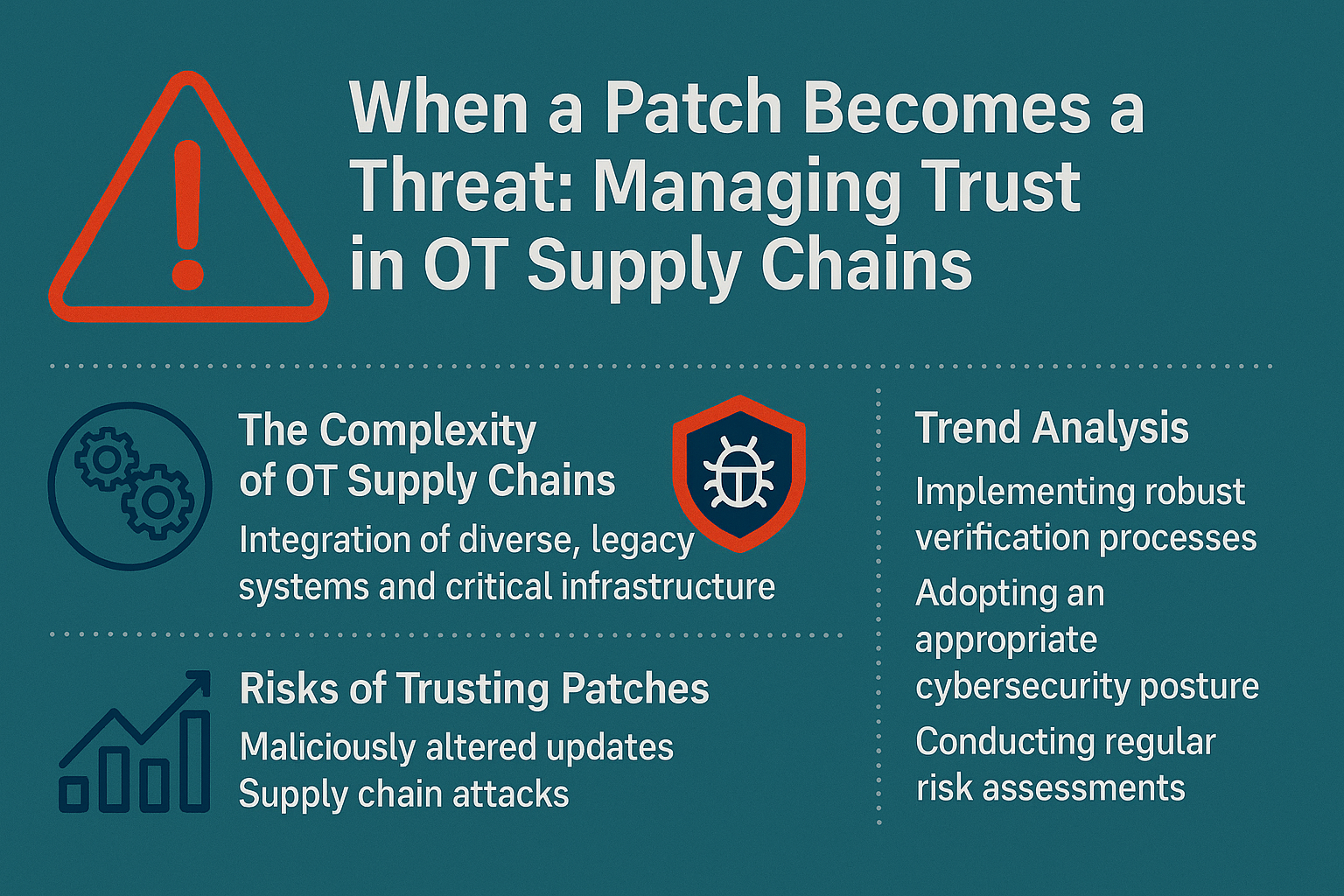
When a Patch Becomes a Threat: Managing Trust in OT Supply Chains

Cyber security admin todayAugust 31, 2025

Background
share close

The Double-Edged Nature of Patches

In Operational Technology (OT) environments—spanning critical infrastructure sectors like oil & gas, energy generation, water treatment, manufacturing, and transportation—patching serves as a cornerstone for maintaining safety, reliability, and regulatory compliance. However, the patching process itself is increasingly under threat. A well-intentioned security update can inadvertently open doors to adversaries, especially when embedded within complex supply chain dependencies. This paradox—patches intended to close gaps becoming vectors for compromise—is gaining prominence as supply chain attacks grow more sophisticated and state-level Advanced Persistent Threats (APTs) exploit presumed trust.

To navigate this landscape, OT stakeholders—asset owners, CISOs, risk managers, and supply chain analysts—need an expanded toolbox: one that includes trend awareness, threat actor profiles, technical controls, and governance frameworks. This article dives deeper into key dimensions of trust in OT patching: evolving supply chain risks, APT-driven exploitation strategies, and a robust, layered defense model ensuring patches truly secure rather than endanger.
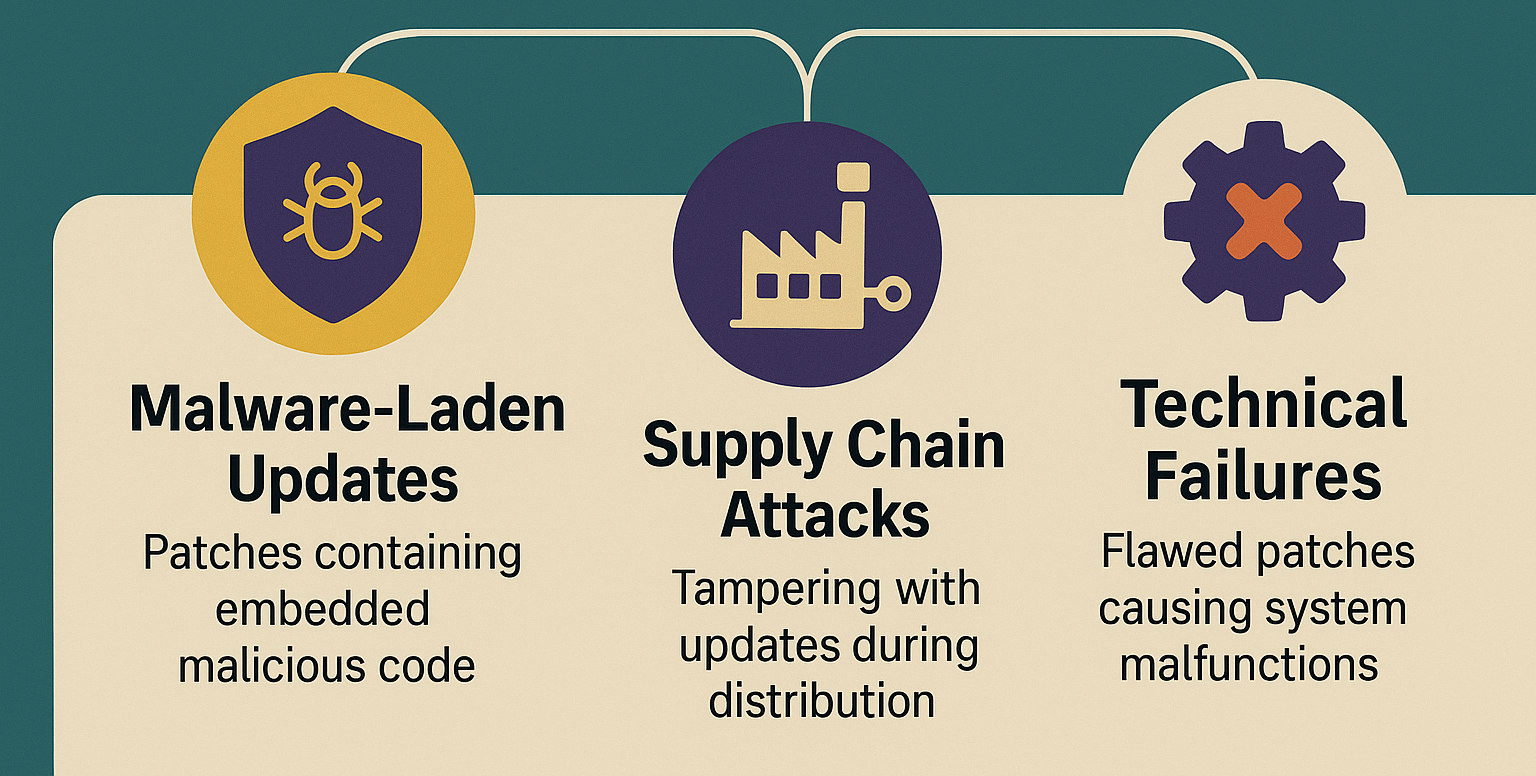
Trend Analysis – Shifting Landscapes in OT Patching and Supply Chain Security

1. Rise of Supply Chain Attacks

Threat actors increasingly target vendor ecosystems rather than individual organizations. Prominent IT incidents—like the SolarWinds breach—have influenced the OT threat landscape. Attackers compromise vendor build systems, injecting malicious code into legitimate updates, which are then automatically rolled out downstream. While the SolarWinds case targeted IT environments, its methodology is directly translatable to OT vendors supplying SCADA firmware and device drivers.

2. Sophistication of APT Campaigns

Nation-state APT groups are leveraging hidden dependencies, backdoors, and poisoned libraries within supply chains to stage long-term infiltration. In OT contexts, such campaigns exploit inherently slower patch cycles and legacy systems that lack robust update validation. Once inside, adversaries can manipulate real-time industrial processes—causing damage without immediately alerting operators.

3. Expansion of Digital Twins, Remote Management, and Cloud-assisted Patching

The advent of remote OT monitoring and management—augmented by cloud-based orchestration—allows vendors and integrators to remotely push updates or firmware. While this improves efficiency and response agility, it also magnifies the blast radius of a compromised patch. A single poisoned update mechanism can affect thousands of geographically distributed assets.

4. Increasing Regulatory and Standards Focus on Supply Chain Security

Governments and regulatory bodies are tightening OT requirements. Standards like IEC 62443-4-1/2/3, NIST SP 800-53, and regional frameworks (e.g., NERC CIP for energy) now explicitly require supply chain risk management, software bill of materials (SBOMs), and patch provenance documentation. Organizations are also pursuing ISO 27001 annexes and assurance programs to comply.

5. Supply Chain Transparency Movement & SBOM Adoption

Mandates—especially in sectors like defense and energy—are pushing vendors to produce SBOMs, verify dependent components, and enact patch traceability. This push is creating a nascent ecosystem of tools that support provenance tracking, dependency graphing, and anomaly detection when applying updates.

How Patches Become Threat Vectors – Tactics, APTs & Technical Failure Modes

Understanding how a patch transitions from remedy to risk involves examining threat vectors:

A. Compromised Vendor Build or Update Infrastructure
  • Attackers infiltrate vendor’s software signing or update mechanisms and inject their own payloads into the build.

  • Updates appear legitimate—signed with the vendor’s certificate—but carry malicious logic.

  • When OT systems auto-update or rely on vendor-provided firmware images, the trust model collapses.

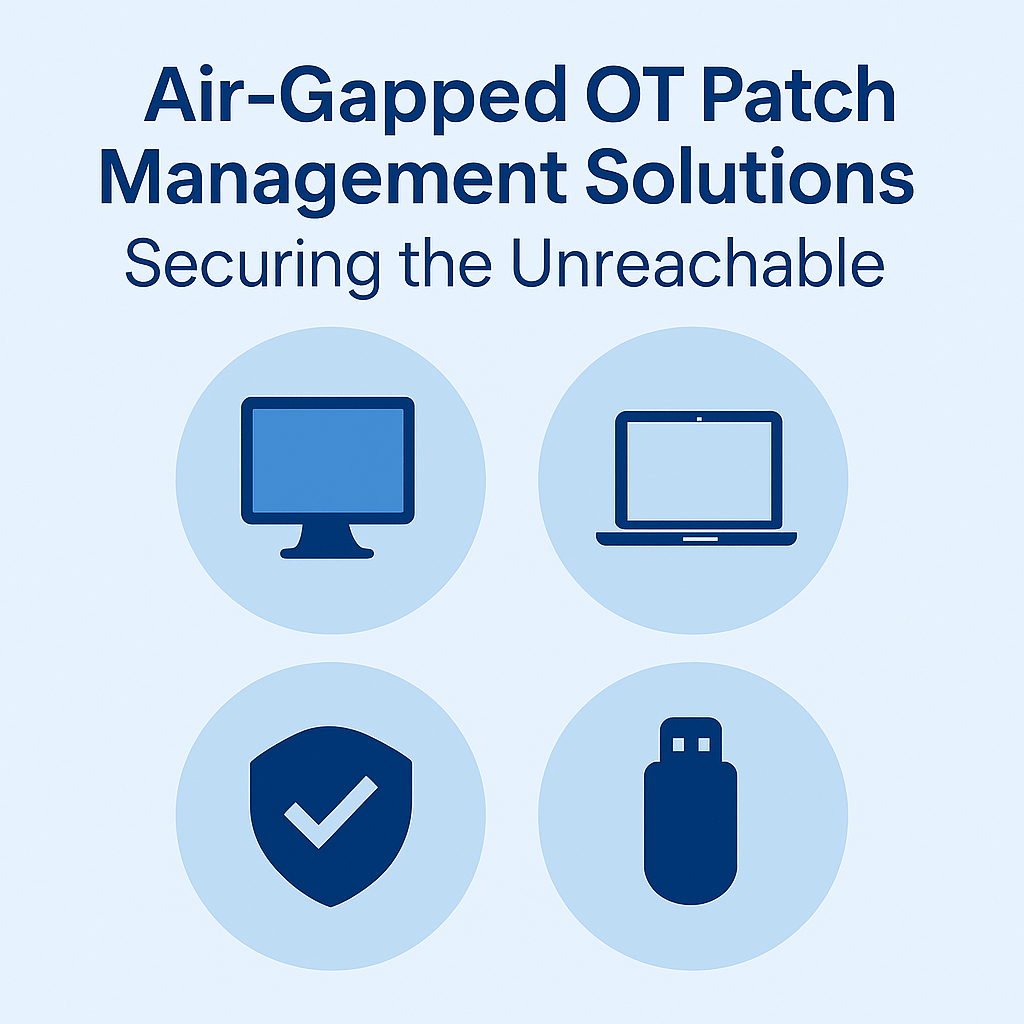
B. Counterfeit or Phished Artifacts in Air-Gapped Environments
  • OT networks often rely on air-gapped patching, where updates are manually downloaded, transferred via USB, DVD, or portable drives.

  • Adversaries may replace or intercept these artifacts—especially if chain-of-custody, endpoint hygiene, or handoff processes are weak.

  • Counterfeit packages (replicated file names, hashes, or certificates) can slip through visible inspection.

C. Insider Threats and Tampering in Offline Transfers
  • Critical infrastructure providers often engage third-party contractors for patch downloads or transport.

  • If contractor environments are compromised, or access controls are lax, tampered patch files can enter secure zones, masquerading as genuine.

D. Tampered Dependencies or Hidden Modules
  • Even an unaltered patch can introduce risk if it contains outdated or vulnerable libraries.

  • A patch may inadvertently re-expose critical CVEs or include backdoors hidden within modules, especially if the SBOM is missing or inaccurate.

E. Inadequate Validation in Sandboxed Environments
  • Operators may deploy patches directly to production, skipping staged testing due to urgency or time constraints.

  • Without proper instrumentation, anomalies in memory use, network behavior, or control logic may go unnoticed.

F. APT-Level Supply Chain Deception
  • Advanced adversaries may employ targeted approaches—distributing specific, weaponized patches only to a subset of high-value targets while distributing benign ones to others, masking their activity.

  • This “targeted poison” reduces detection likelihood and enables stealthy long-term intrusion.

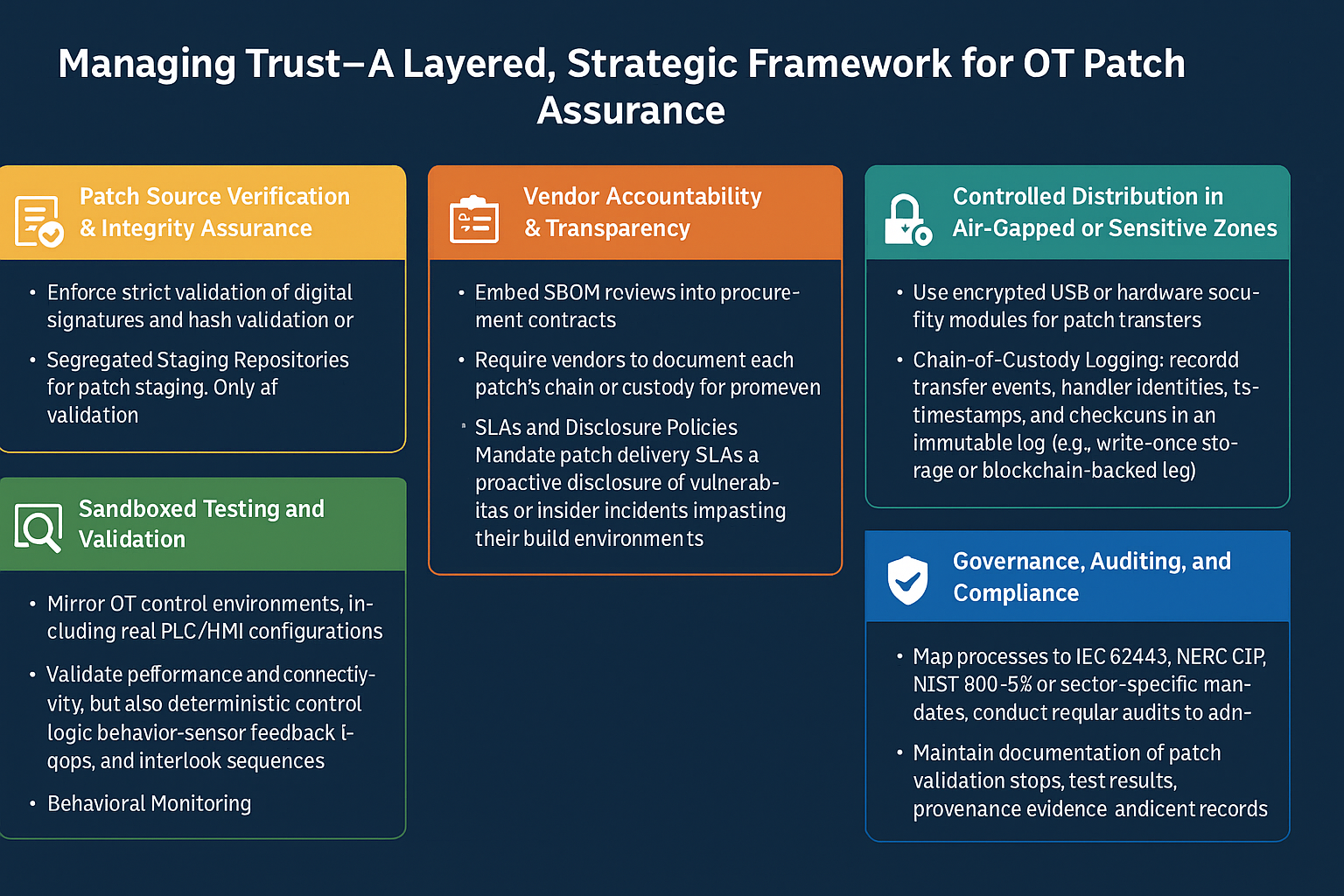
Managing Trust—A Layered, Strategic Framework for OT Patch Assurance

To ensure a patch reduces risk rather than implementing it, OT organizations must adopt a multi-layered, holistic strategy, consisting of:

1. Patch Source Verification & Integrity Assurance
  • Digital Signatures and Hash Validation: Enforce strict validation of signatures and hash values before a patch enters an OT vault. Hashes should be obtained directly from vendor sites over secure channels or via SBOM-managed tooling.

  • Segregated Staging Repositories: Establish dedicated, audited repositories for patch staging. Only after validation should a patch be promoted to deployment endpoints.

  • Reproducible Builds: Where feasible, implement vendor-supplied build scripts and version-controlled environments to independently verify that binary artifacts correspond to published source.

2. Vendor Accountability & Transparency
  • SBOM Requirements and Verification: Embed SBOM reviews into procurement contracts. Ask vendors for the full dependency graph, including third-party components and versioning.

  • Patch Provenance Reporting: Require vendors to document the chain of custody for each patch—who built it, when, through what pipeline.

  • SLAs and Disclosure Policies: Mandate patch delivery SLAs and proactive disclosure of vulnerabilities and insider incidents impacting their build environments.

3. Controlled Distribution in Air-Gapped or Sensitive Zones
  • Physical Security & Transfer Controls: Use encrypted USB or hardware security modules (HSMs) for patch transfers. Optionally, use data diodes or read-only media where writeback is impossible.

  • Chain-of-Custody Logging: For each artifact, record transfer events, handler identities, timestamps, and checksums in an immutable log (e.g., write-once storage or blockchain-backed ledger).

  • Endpoint Integrity Checks: On arrival, perform scans verifying file integrity—hash re-calculation, signature verification, and anomaly detection (e.g., unexpected size or structure).

4. Sandboxed Testing and Validation
  • Virtualized/Emulated Testbeds: Mirror OT control environments—and ideally use real PLC/HMI configurations—to deploy patches safely.

  • Functional and Safety Testing: Validate not only performance and connectivity, but also deterministic control logic behavior, sensor feedback loops, and interlock sequences.

  • Behavioral Monitoring: Watch for unusual network traffic, memory spikes, process anomalies, or kernel-level hooks introduced by the patch.

5. Post-Deployment Monitoring & Incident Response
  • Incremental Roll-Outs: Apply patches to a small, representative sample of systems first, before scaling deployment.

  • Security Event Monitoring: Connect patched systems to Security Information and Event Management (SIEM) or Intrusion Detection Systems (IDS) that flag unusual behavior immediately post-deployment.

  • Rapid Rollback Plans: Maintain tested snapshots and rollback capability to return to known-good configurations should a patch cause instability or exhibit malicious behavior.

6. Governance, Auditing, and Compliance
  • Policy Alignment with Standards: Map your process to IEC 62443, NERC CIP, NIST 800-53, or sector-specific mandates, and conduct regular audits to validate adherence.

  • Assurance Reporting: Maintain documentation of patch validation steps, test results, provenance evidence, and incident records.

  • Executive Oversight: Ensure risk-based patch decisions are reviewed by both cybersecurity and operational leadership—aligning risk appetite with process compliance.

How REPLIL Helps Manage Trust in OT Supply Chains

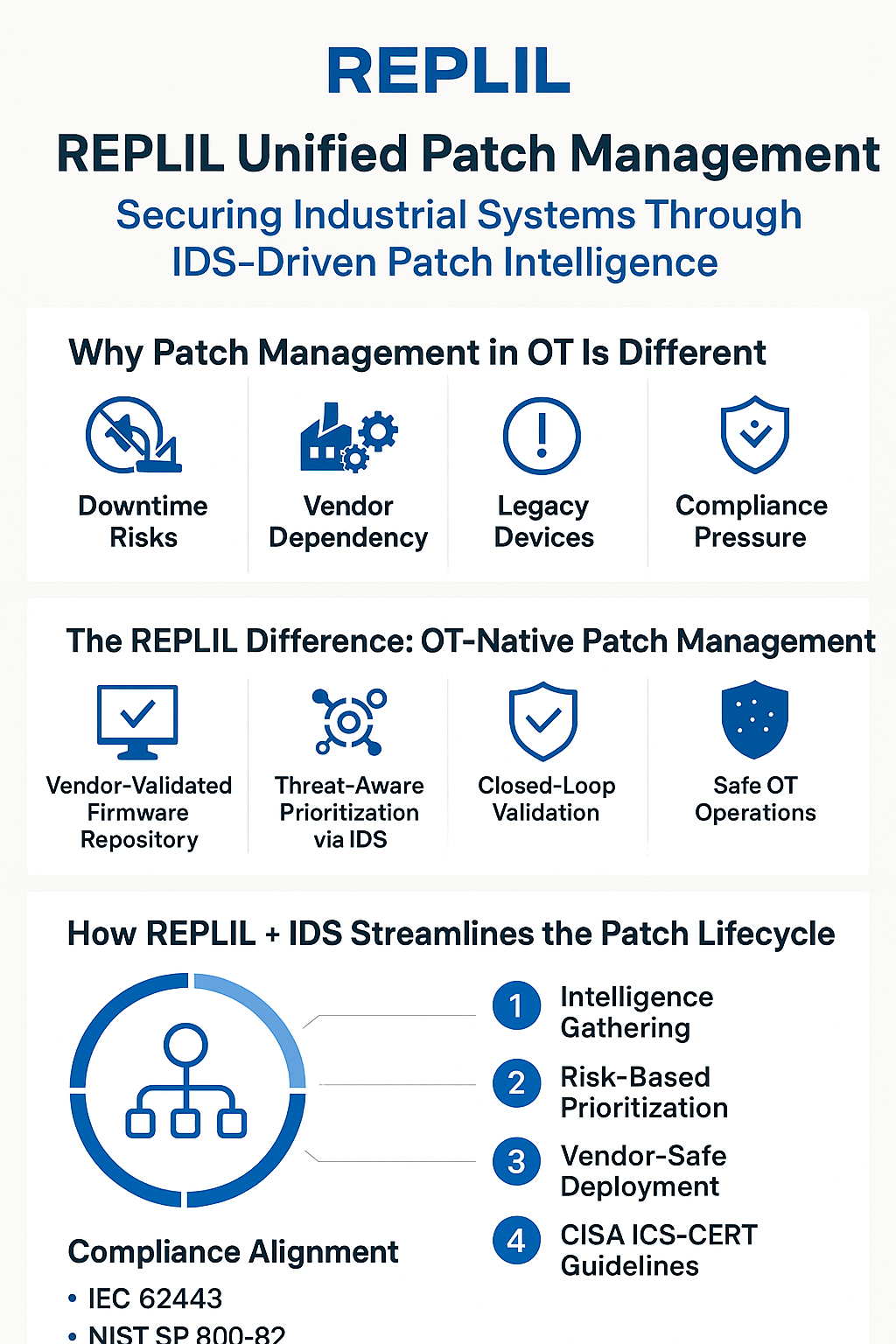
REPLIL Industrial Patch Manager (IPM) is designed to address the exact challenges of trust, authenticity, and validation that asset owners face when dealing with vendor patches in critical OT environments. By embedding security and compliance controls directly into the patch management lifecycle, REPLIL ensures that organizations can patch with confidence while maintaining operational integrity.

Key Ways REPLIL Strengthens Trust in Supply Chains:

  • Vendor-Approved Patch Validation
    REPLIL maintains a structured patch validation process through the REPLIL OT Patch Sandbox, where patches are tested in before deployment. This eliminates the uncertainty of applying unverified updates that could disrupt industrial systems.

  • Digital Trust & Integrity Verification
    Every patch and update is checked against digital signatures, metadata, and vendor release notes to verify its origin and authenticity. REPLIL prevents tampered or rogue updates from entering the OT network, addressing one of the biggest risks in supply chain compromise.

  • Unified Visibility Across Assets
    From DCS systems to network infrastructure and third-party applications, REPLIL provides a single platform to view patch availability, approval status, and deployment readiness. This unified visibility reduces the blind spots that attackers often exploit in fragmented patch processes.

  • Risk-Based Patching & KPIs
    REPLIL applies a risk-based triage model that factors in CVSS, EPSS, and CIA impact to prioritize patching decisions. Asset owners can align patch deployments with both operational safety and cybersecurity KPIs—moving from reactive patching to proactive risk reduction.

  • Compliance with IEC 62443 and NCA OTCC
    By embedding compliance frameworks, REPLIL ensures that every patch action—from download to deployment—is auditable and aligned with global standards. This helps asset owners prove not only that they patched, but that they patched responsibly.

Infusing APT Awareness into Patch Trust Management

APT actors are not generic threats—they are motivated, persistent, and adaptive. Securing patch supply chains against them requires awareness of their tactics and targeted mitigation:

1. Understanding APT Tactics
  • Supply Chain Poisoning: Compromising software, firmware, or update servers to plant malware in legitimate packages.

  • Living-Off-The-Land Binaries (LOLBins): Embedding code that uses legitimate OS utilities for stealth operations.

  • Selective Targeting: Sending weaponized patches only to specific geolocation or IP-range targets, making detection rare.

2. Counter-APT Controls
  • Behavioral Baselines: Establish normal patch behavior. Any deviation in execution patterns—unusual connections, process launches—should trigger alerts.

  • Off-Path Verification: Use separate verification infrastructure (e.g., air-gapped labs) to test patches before distributing them within the OT environment.

  • Threat Intelligence Feeds: Integrate IOCs (Indicators of Compromise) and TTPs (Tactics, Techniques, and Procedures) related to known APT groups targeting OT, such as Dragonfly (Energetic Bear), Sandworm, or Barium, to flag suspicious patch behavior.

  • Red-Team Simulations: Conduct controlled supply chain compromise drills—simulate malicious patch injection to test detection and response readiness.

Industry Benchmarks and Momentum

1. Regulatory Momentum
  • U.S. Executive Order 14028 mandates SBOM creation, software integrity standards, and supply chain software security—a strong signal that software provenance is now critical at federal level.

  • EU Cyber Resilience Act is pushing software manufacturers to implement security through the lifecycle, focusing beyond code to supply chain impact.

2. Vendor-Side Innovation
  • OT vendors are beginning to provide cryptographically-signed delta updates, tamper-evident delivery packages, and cloud-based compliance dashboards for tracking patch statuses and SBOMs.

3. Cross-Sector Collaboration
  • Information Sharing: ISACs like the U.S. ISA-99 (now part of ISC) and Europe’s ENISA facilitate sharing of supply chain attack intelligence and patch anomalies among peers.

  • Consortium Standards: The Open Process Automation Forum (OPAF) and other consortia are building standards around patch integrity and validation in automated control ecosystems.

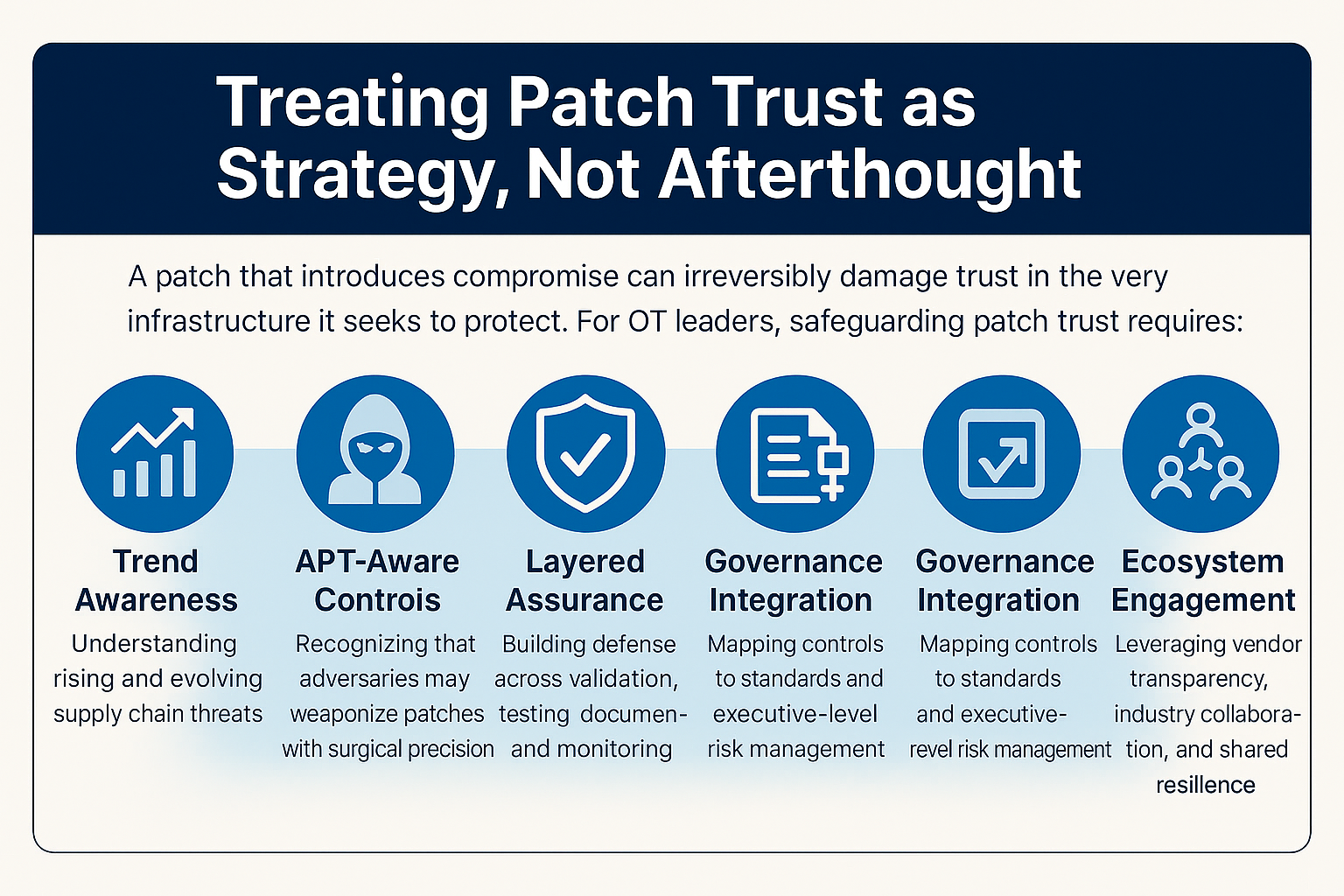
A patch that introduces compromise can irreversibly damage trust in the very infrastructure it seeks to protect. For OT leaders, safeguarding patch trust requires:

  • Trend Awareness — Understanding rising and evolving supply chain threats.

  • APT-Aware Controls — Recognizing that adversaries may weaponize patches with surgical precision.

  • Layered Assurance — Building defense across validation, testing, documentation, and monitoring.

  • Governance Integration — Mapping controls to standards and executive-level risk management.

  • Ecosystem Engagement — Leveraging vendor transparency, industry collaboration, and shared resilience.

By integrating digital signature enforcement, SBOM-based transparency, sandbox validation, incident-aware rollouts, and governance oversight, OT organizations can transform the patching process from a potential liability into a strategic asset for security and trust.

Written by: admin

Rate it
Previous post