


Air-Gapped OT Patch Management Solutions: Securing the Unreachable
In today’s volatile cyber landscape, protecting Operational Technology (OT) environments from cyber threats is a non-negotiable imperative. But when it comes to air-gapped systems—those physically or logically isolated from external networks—the task of patch management becomes uniquely challenging.
These environments are commonly found in critical infrastructure such as:
- Nuclear power plants
- Oil and gas refineries
- Water treatment facilities
- Industrial manufacturing plants
- Defense and military systems
While air gaps are effective in reducing exposure to external threats, they simultaneously introduce complexities in updating, verifying, and managing patches. This article explores the challenges and solutions in delivering secure, efficient, and verifiable patch management for air-gapped OT networks.
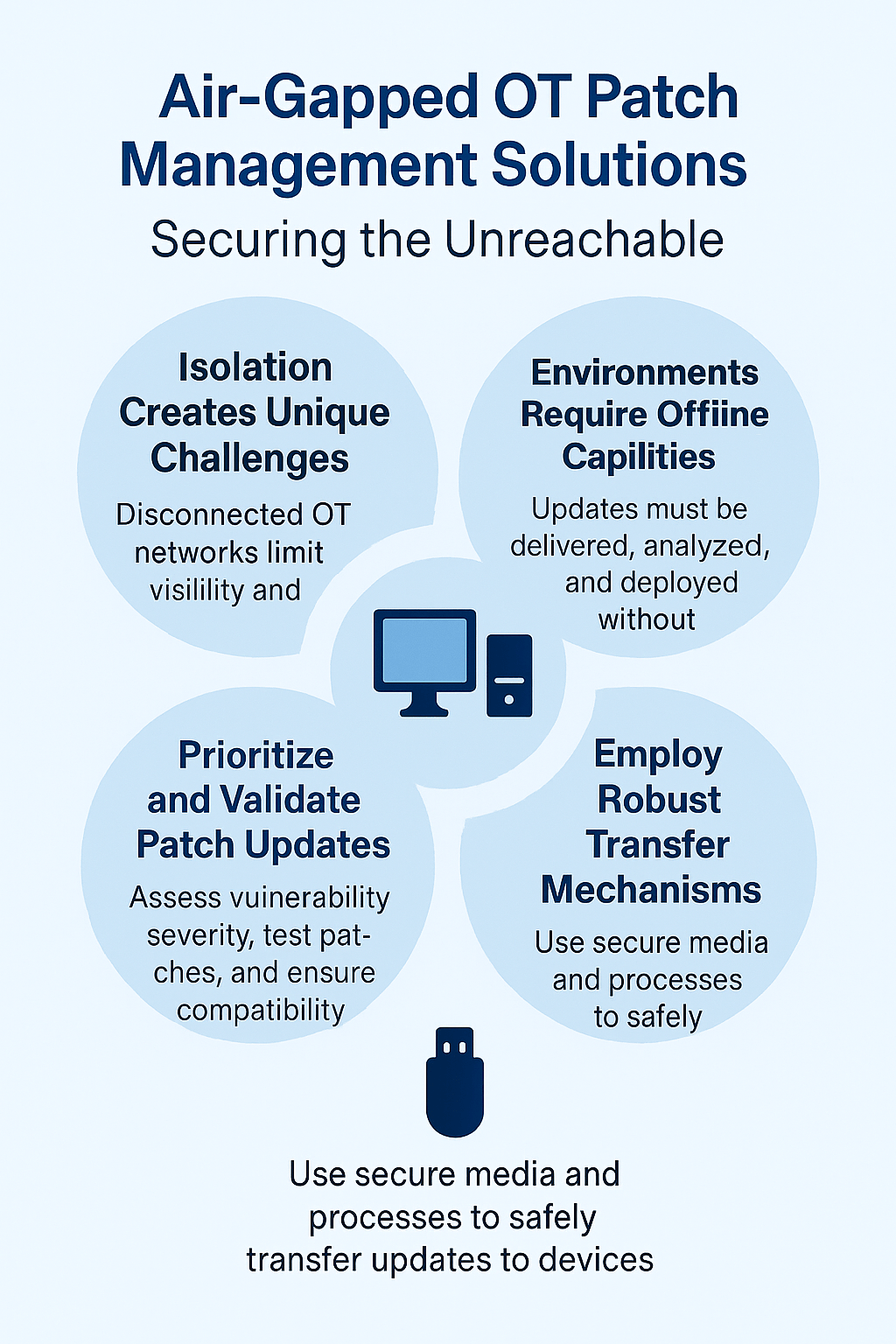
The Challenge: Why Air-Gapped Systems Are Difficult to Patch
Air-gapped networks typically:
- Have no internet connectivity to access patch repositories.
- Disallow remote access, making centralized control difficult.
- Depend heavily on vendor approvals and proprietary software.
- Operate on legacy systems that have strict uptime requirements and cannot be restarted frequently.
Consequently, the traditional approach to patch management—automated downloads, remote deployment, real-time compliance—is not feasible in such environments.
Key Risks of Inadequate Patch Management in Air-Gapped OT Systems
Despite their isolation, air-gapped systems face real threats:
- Insider threats via USBs, removable media, or misconfigured devices.
- Supply chain attacks through compromised vendor packages.
- Delayed threat mitigation due to long patch cycles.
- Compliance violations under regulations such as IEC 62443, NIST SP 800-82, and NERC CIP.
An unpatched system, regardless of its isolation, remains vulnerable to attack vectors that bypass the air gap.
Essential Capabilities of Air-Gapped OT Patch Management Solutions
To effectively manage patches in isolated networks, solutions must offer:
1. Offline Patch Repository & Packaging
- Export OS, application, firmware, and 3rd-party patches into secure, signed bundles.
- Allow validation of patch integrity using SHA-256 or digital signatures.
2. Portable Patch Transfer Mechanism
- Support for secure media (e.g., encrypted USB drives or DVDs).
- Media validation checks before acceptance into the OT zone.
3. Patch Applicability Validation
- Map patches to asset inventory offline.
- Validate against vendor-approved advisories.
- Detect superseded updates or incompatible configurations.
4. Sandbox or Testbed Verification
- Simulate patch application in a mirror of production before actual deployment.
- Track configuration drift and rollback scenarios.
5. Audit & Compliance Reporting
- Document patch actions, signatures, personnel, and timestamps.
- Produce reports aligned with IEC 62443 and NIST frameworks.
How REPLIL IPM Addresses Air-Gapped Patch Management
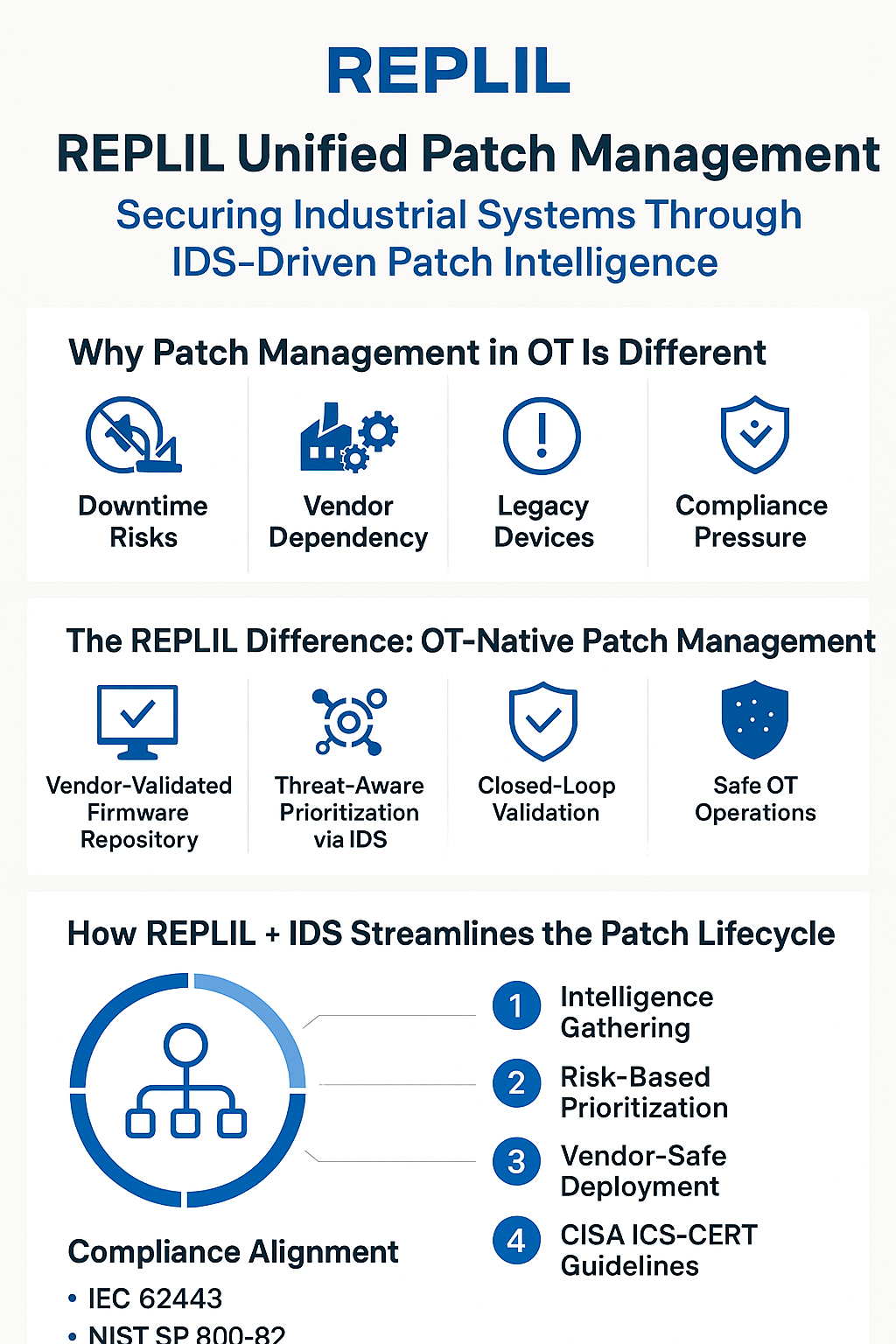
REPLIL Industrial Patch Manager (IPM) is designed with air-gapped OT environments in mind. It delivers:
- Offline patch packaging for OS, firmware, and application updates.
- Secure content transfer workflows with SHA-256 verification and user-based controls.
- Patch validation engine (REPLIL OT PATCH SANDBOX) that works offline to evaluate applicability, supersedence, and vendor dependencies.
- Digital audit trail generation for full traceability across environments.
- Pre-deployment test validation tools to ensure compatibility before production rollout.
With REPLIL IPM, industrial organizations can manage patches efficiently—without compromising isolation or uptime.
Best Practices for Air-Gapped Patch Management
- Establish a Patch Governance Policy – Define roles, approval chains, media control policies, and risk thresholds.
- Use Only Vendor-Validated Updates – Apply updates only after validation or certification from the asset or system vendor.
- Implement a Secure Patch Staging Process – Maintain a staging area outside the OT zone to prepare, sign, and validate updates before transfer.
- Audit Everything – Use logs and digital signatures to ensure accountability and compliance.
- Test Before Apply – Never patch directly in production. Always simulate in an offline testbed.
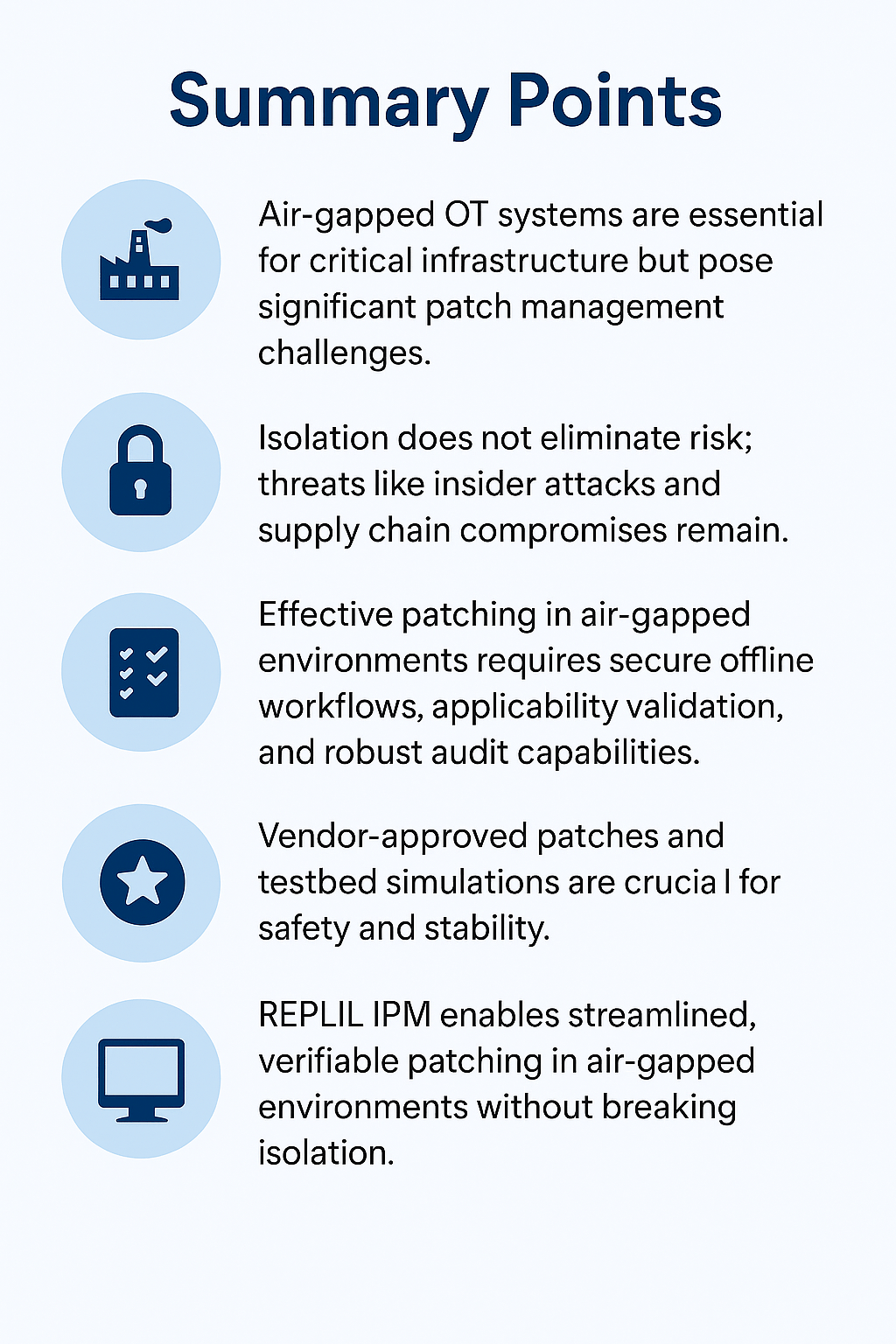
Summary Points
- Air-gapped OT systems are essential for critical infrastructure but pose significant patch management challenges.
- Isolation does not eliminate risk; threats like insider attacks and supply chain compromises remain.
- Effective patching in air-gapped environments requires secure offline workflows, applicability validation, and robust audit capabilities.
- Vendor-approved patches and testbed simulations are crucial for safety and stability.
- REPLIL IPM enables streamlined, verifiable patching in air-gapped environments without breaking isolation.
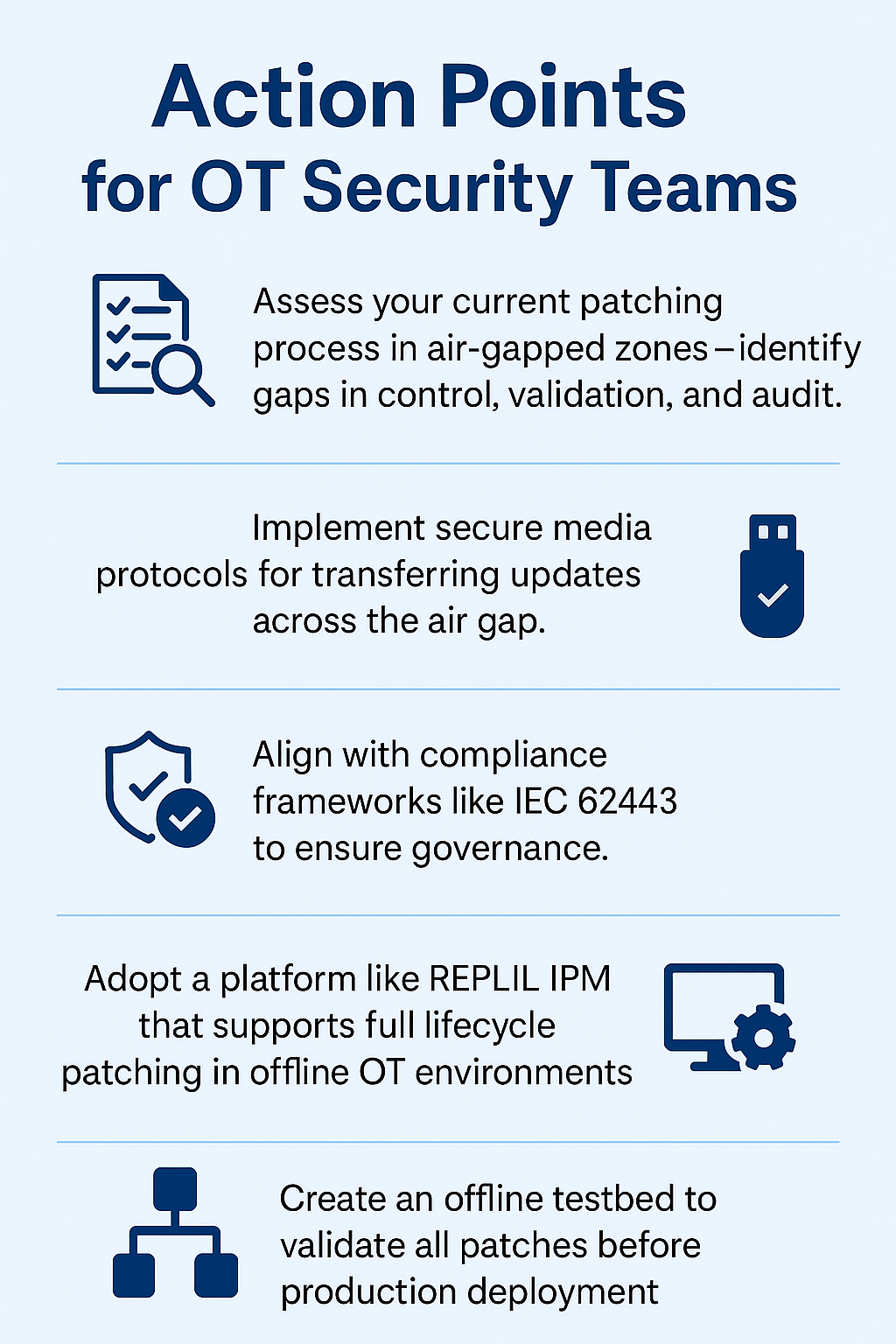
Action Points for OT Security Teams
- Assess your current patching process in air-gapped zones—identify gaps in control, validation, and audit.
- Implement secure media protocols for transferring updates across the air gap.
- Align with compliance frameworks like IEC 62443 to ensure governance.
- Adopt a platform like REPLIL IPM that supports full lifecycle patching in offline OT environments.
- Create an offline testbed to validate all patches before production deployment.
Conclusion: Isolation Is Not Immunity
Air-gapped systems provide a strong defense, but they are not invincible. Without timely and validated patching, even the most isolated OT network can become a liability.
Effective air-gapped patch management is not just about transferring files—it’s about safeguarding integrity, maintaining trust, and complying with industry standards.
Solutions like REPLIL IPM enable organizations to bring structure, automation, and control to environments once thought to be unmanageable.
When it comes to patching the unreachable—process, policy, and technology must align. And with the right tools, even air-gapped systems can stay secure, updated, and resilient.