
Refrigeration controllers, building-management systems and remote engineering workstations belong in the OT security conversation. A support connection can become a route to equipment whose failure affects production, stored goods or essential services. The practical question is whether an operator can identify that route, control the maintenance activity and verify the condition of the process afterward.
The November 2026 cold-chain warnings bring that question into focus. This article translates the current guidance into an operational workflow: establish ownership, constrain access, control credentials, assess and test changes, and retain evidence that the system returned to its intended state.
Why this matters now
On 5 November 2026, CISA, the FBI and U.S. government partners issued a joint fact sheet on industrial refrigeration and cold-chain monitoring systems. It describes malicious activity against temperature and refrigeration controllers and warns that unauthorized changes can affect equipment and stored inventory. Its recommended controls include reducing internet exposure, strengthening authentication, maintaining firmware, testing backups and monitoring activity.
Singapore’s Cyber Security Agency followed with a 6 November advisory on remotely accessible OT control systems. It reported incidents involving refrigeration management in Europe, while noting that the precise intrusion methods across affected systems remained under investigation. On 10 November, the FBI highlighted the warning again, including an attempted disruption where staff response to alarms helped avoid loss of stored blood.
The lesson is broader than refrigeration: a remote maintenance path is part of the operational risk assessment. The workflow below is REPLIL’s practical interpretation for asset owners and integrators; it is not an incident reconstruction or a claim that the referenced agencies endorse a particular product.
The short version
- Know the asset, its owner and every approved route used to reach it.
- Authorize a named person for a specific task, asset and time window.
- Separate access permission from permission to change software or configuration.
- Validate applicable patches against the actual system and application baseline.
- Close the session only after checking the operational result and preserving evidence.
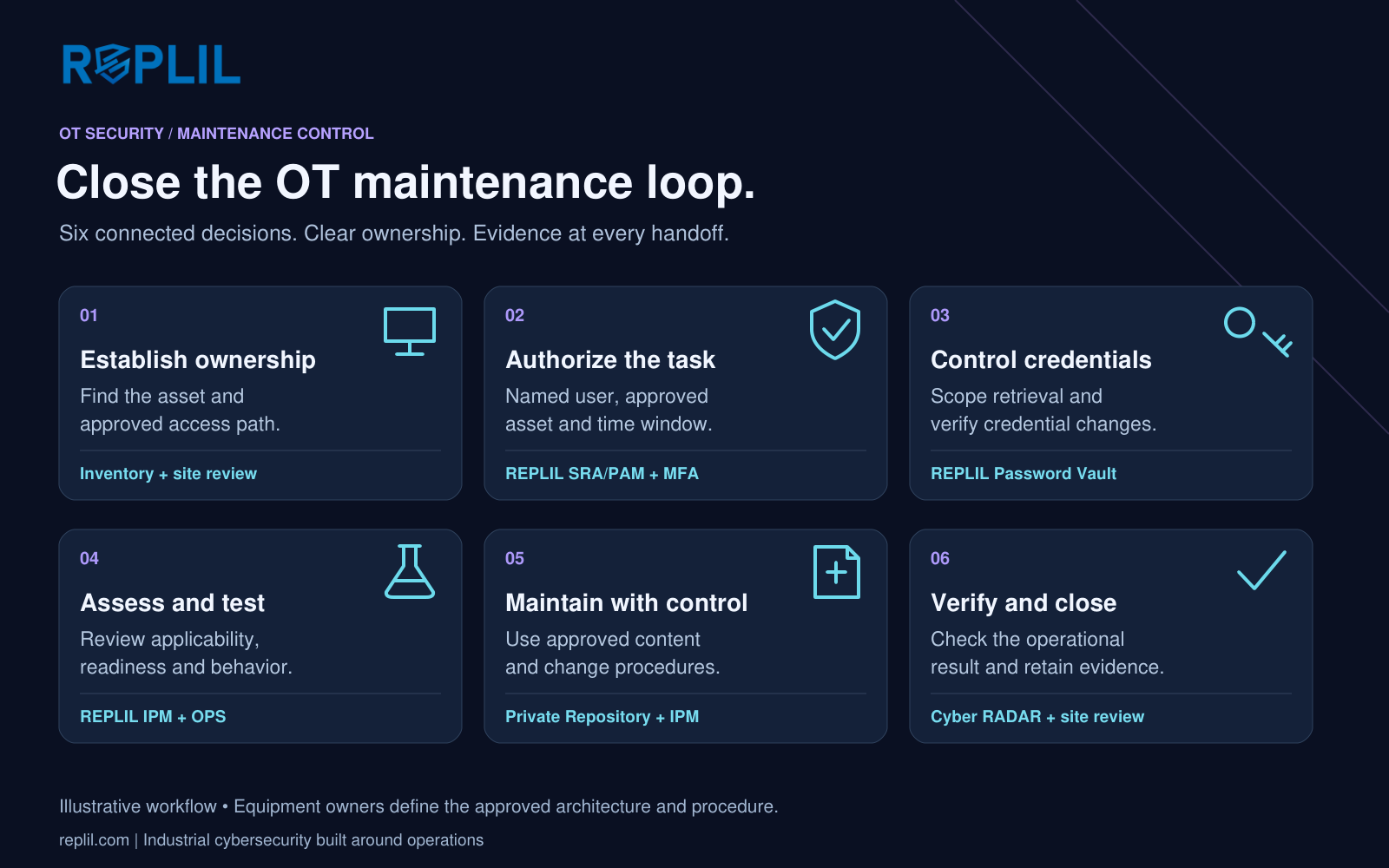
1. Establish the real maintenance boundary
A controller may have no intended enterprise connection yet remain reachable through a vendor appliance, cellular router or temporary support path. The Canadian Centre for Cyber Security’s September 2026 warning specifically discusses undocumented third-party connections and unintentionally exposed systems. A network drawing alone is insufficient evidence that a system is isolated.
Build a maintenance-path register that links each relevant asset to its operational owner, support provider, approved source, access gateway, permitted protocol and accountable approver. Record which connections are permanent and which should disappear after a task. Include engineering stations, supervisory applications and the network devices supporting them.
Verify exposure through approved external assessments and a review of network and vendor-access configurations. Coordinate intrusive testing with operations and equipment owners. The useful deliverable is an agreed access boundary with a named owner for each exception, rather than an unreviewed list of discovered addresses.
2. Authorize the task before opening the session
A contractor’s valid account does not establish permission to access every asset at every site. For each maintenance request, identify the person, purpose, target systems, allowed activities, start and end time, and the operator who can stop the work. Specify whether observation is sufficient or interactive control is necessary.
REPLIL SRA/PAM supports approved, time-bound remote sessions, recording, auditing and operational oversight. Use those capabilities to connect a session to an accountable maintenance decision. Keep the granted scope aligned with the task, and terminate access when the approved work or time window ends.
Authentication is a separate control. REPLIL MFA supports authentication workflows for supported Windows and network assets. Select an appropriate multifactor method for the access system, and prefer phishing-resistant methods where supported by the identity architecture. A successful MFA challenge does not authorize an unapproved production change, and an access gateway does not automatically remove other exposed maintenance paths.
3. Treat credential use as a controlled activity
Shared credentials make attribution and offboarding difficult. Identify the accounts used by people, applications, scheduled jobs and integrations before changing them. A password rotation that breaks a dependent service can create an operational problem of its own.
REPLIL Password Vault provides controlled credential retrieval and rotation workflows. Define who may retrieve a credential, for which asset and purpose, and how its use is reviewed. For supported integrations, keep credential handling connected to the authorized operational workflow rather than distributing passwords through informal messages.
Before rotation, list dependencies and agree how to test them. After rotation, verify that authorized access and required services still work, while retired credentials no longer provide access. Emergency access should have an accountable release and review procedure, with recovery material protected separately.
4. Separate urgent containment from the patch decision
Removing unnecessary exposure and changing software are different work packages. An access restriction may reduce immediate risk while an update is evaluated, but it should not become an undocumented reason to postpone remediation indefinitely. Assign an owner and review date to temporary treatments.
REPLIL Industrial Patch Manager connects inventory, missing and installed patches, vendor qualification information and endpoint readiness for supported assets. Use the exact operating-system, application and firmware baseline when assessing applicability. A vendor-qualified patch list is decision evidence for its stated scope; it does not establish compatibility with every surrounding application or controller configuration.
REPLIL Private Repository supports acquisition and central organization of qualified patch-list and firmware content from supported vendor sources. Preserve the source, package identity, version and relevant qualification reference through the change record. This is especially useful when a facility’s approved process requires staged or offline content transfer.
5. Test the application outcome, then execute within a defined window
A patch installation result answers only part of the change question. The process may still depend on an operator display, alarm path, historian interface, service account or application-to-device connection. Establish the pre-change baseline and decide what evidence will demonstrate acceptable behavior afterward.
REPLIL OPS, the OT Patch Sandbox, supports isolated patch testing and examination of application behavior, critical services, registry changes and performance. Choose representative test cases for the affected workflow and document what the test environment does and does not represent.
For an illustrative cold-storage supervisory system, a site test plan might check application startup, supported controller communications, event delivery and authorized setpoint-change workflows before and after the proposed update. Equipment specialists must define process-safe test conditions. A general application test is not a substitute for validating the refrigeration process or its independent protective functions.
Before production execution, confirm the backup and restoration procedure, maintenance allowance, restart sequence, stop criteria and decision owner. NIST SP 800-82 Rev. 3 provides the wider OT security context: safety, reliability and operational constraints must remain part of security decisions.
6. Close the change with operational and security evidence
Define closure criteria before the maintenance session starts. For example: the approved software baseline is confirmed; the application and required interfaces behave as expected; alarm delivery reaches the responsible personnel; temporary access has ended; and any remaining exception has an owner and review date.
REPLIL Cyber RADAR supports collection and review of operating-system and network logs, relevant event detection and dashboards. Correlate available access and system events with the work request and change timeline. A security log platform complements process monitoring; it does not replace equipment-specific temperature alarms, safe operating limits or an operator’s process checks.
Retain a concise evidence package: asset baseline, approval, session reference, content provenance, test result, deployment outcome, post-change checks and exception decision. It should let the next shift understand what changed and what remains unresolved without recreating the investigation.
A practical review table for the next maintenance window
| Review question | Evidence to retain | Relevant REPLIL capability |
|---|---|---|
| Who may reach the asset, and for what task? | Named approval, asset scope, session window and access record | SRA/PAM; MFA for supported access scenarios |
| How are privileged credentials used? | Retrieval authorization, dependency review and rotation verification | Password Vault |
| Is the proposed update appropriate? | Inventory baseline, applicable vendor reference and readiness result | Industrial Patch Manager; Private Repository |
| Was application behavior checked? | Before-and-after test cases, observations and approval | OT Patch Sandbox |
| Did the change close safely? | Operational checks, relevant events and removal of temporary access | Cyber RADAR; SRA/PAM audit records; site procedures |
What asset owners can do next
Select one maintenance path that matters to operations. Trace it from the outside user to the target asset, then trace the associated patch and credential workflow. Ask the operations owner, integrator and security team to agree on the evidence required at each handoff.
For refrigeration, building systems, water, manufacturing and other industrial environments, the goal is a maintenance process that can be authorized, executed and reconstructed with confidence. Start with the operational dependency and choose the controls that fit it.
Request a REPLIL walkthrough to explore how SRA/PAM, Industrial Patch Manager, OT Patch Sandbox, Private Repository, Password Vault and Cyber RADAR can support your facility’s approved workflow.
Frequently asked questions
Does this article mean REPLIL patches every refrigeration controller?
No. Applicability depends on the device, vendor, platform and supported product workflow. Identify the exact equipment and vendor maintenance requirements before selecting a deployment method.
Is MFA enough to secure a vendor maintenance session?
MFA strengthens authentication. The session still needs appropriate asset scope, approval, duration, credential controls, monitoring and a process for ending access.
Should every newly released patch be deployed immediately to OT?
Assess the exposure and available immediate treatments, then evaluate applicability, vendor guidance, testing, recovery and operational timing. Urgency should inform the decision and escalation process rather than remove engineering controls.
Sources and further reading
- U.S. government joint fact sheet: Industrial Refrigeration and Cold Chain Monitoring Systems — 5 November 2026.
- Cyber Security Agency of Singapore: Remotely Accessible OT Control Systems — 6 November 2026.
- FBI News Blog: Advisory to Help Organizations Freeze Out Hackers — 10 November 2026.
- Canadian Centre for Cyber Security: Internet-Exposed PLC Campaign — modified 14 September 2026.
- NIST SP 800-82 Rev. 3: Guide to Operational Technology Security.
Sources reviewed 13 November 2026. Incident descriptions are attributed to the named authorities; investigation findings may evolve. Product coverage depends on the supported platform and deployment design. Third-party names belong to their respective owners and do not imply affiliation or endorsement.