
At a glance: A qualified patch list is evidence about a defined vendor configuration. Correlate it with the actual asset baseline, preserve its conditions and retain the site decision separately from the vendor result.
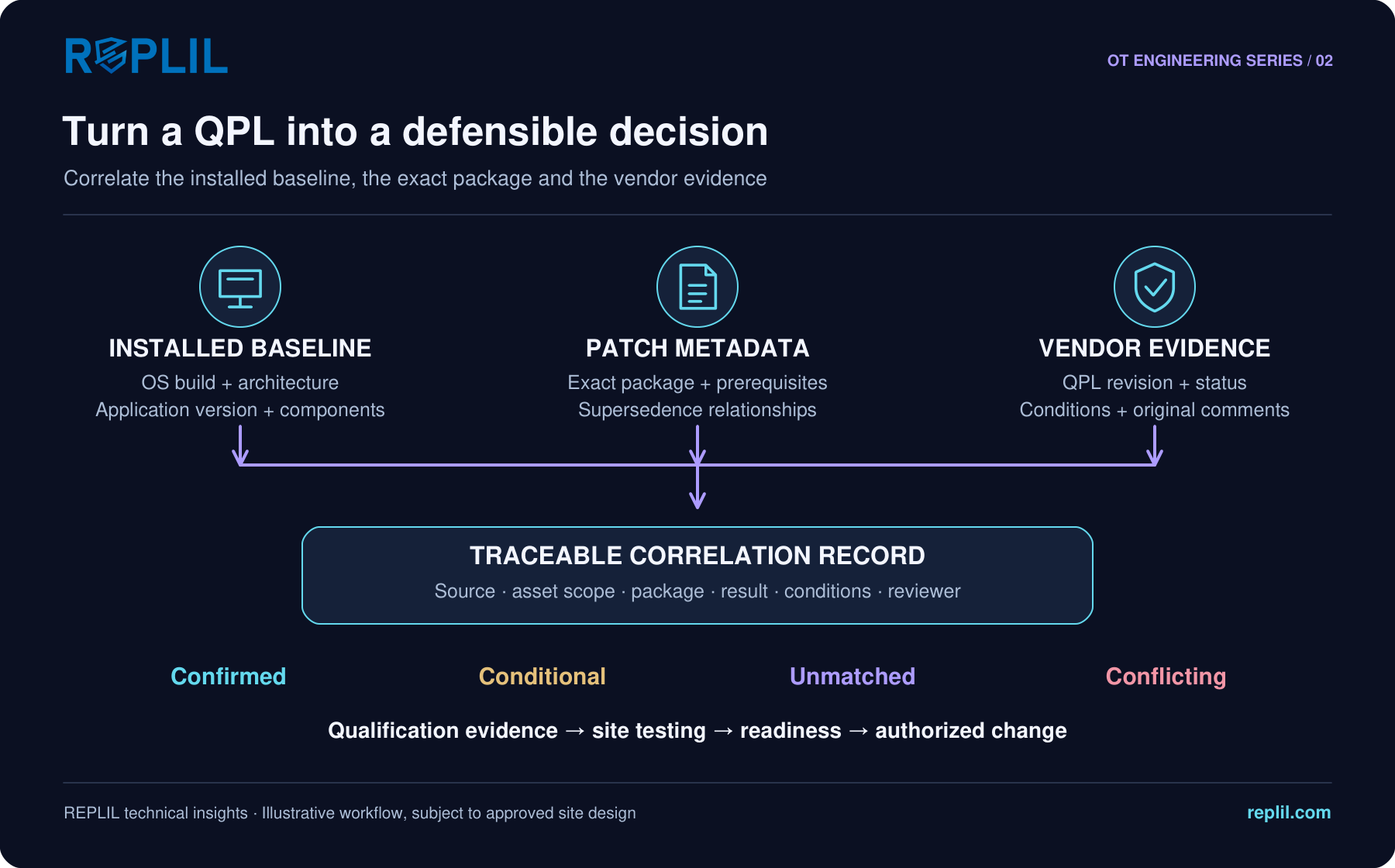
The difficult part is the relationship between records
A patch identifier is easy to collect. Establishing what it means for a particular industrial application is harder. The same operating-system update can appear in several vendor references with different application versions, component combinations, qualifications or comments. A match on a KB number alone can erase those distinctions.
Effective qualified patch list correlation joins three evidence sets: the installed asset and application baseline, the operating-system or application package, and the vendor’s qualification information. The output should be a reviewable relationship, not an unexplained approved label.
IEC TR 62443-2-3:2015 addresses patch-management information exchange between industrial asset owners and product suppliers. That public description supports treating patch information as part of a managed exchange; it does not make every vendor list an approval for every site configuration.
Define a correlation key that is specific enough
Capture the operating-system family, edition, build, architecture and relevant installed packages. For the industrial application, collect the product name, exact version, service pack, hotfix level, installed components and asset role. Preserve the vendor’s product identifier as well as a normalized display name.
On the qualification side, retain the source document or portal reference, revision, retrieval time, applicable application and OS combinations, package identifiers, stated result and comments. Where the source distinguishes tested, recommended, excluded or pending items, keep those states distinct.
Normalization helps search; it must not manufacture equivalence. Two similar application names may refer to different components. A vendor family match can create a candidate for review, but should not silently become a version-level qualification result.
Preserve source meaning when importing a QPL
Treat the source as a versioned evidence object. Store the original file or reference with its publication or revision date when available. Record acquisition time separately: downloading an old document today does not make its contents current.
Retain comments and exclusions during extraction. A spreadsheet cell explaining a replacement, component dependency or version constraint may be more important than the headline tested status. Siemens’ PCS 7 compendium provides a concrete example of a vendor workflow that uses a compatibility spreadsheet and checks replacement comments. It illustrates why a flat list of patch numbers is insufficient.
When automated extraction changes, compare the new output against known source examples. Detect missing columns, unexpected status values and large row-count changes before distributing the data. A successful file download does not prove that its meaning was parsed correctly.
Handle four correlation outcomes explicitly
A confirmed match links the package, asset baseline and applicable vendor qualification with no unresolved conditions. Attach the supporting source revision and send the candidate onward to site testing and readiness assessment.
A conditional match identifies a requirement that still needs resolution, such as a component version, prerequisite or vendor comment. Present that condition directly to the reviewer. A missing match means the available evidence did not establish a relationship; it is not proof that the patch is incompatible or safe.
A conflicting match requires investigation. Examples include a newer reference changing the status of a package or two source records addressing different configurations that have been mistakenly combined. Retain both records and identify the decision owner instead of allowing the newest import to overwrite the history without explanation.
Manage supersedence without losing qualification context
Operating-system servicing can replace earlier packages with cumulative updates, but technical supersedence and vendor qualification answer different questions. A later package may include earlier fixes while still requiring its own qualification and site assessment.
Use supersedence metadata to explain package relationships and reduce obsolete deployment candidates. Do not inherit a previous package’s vendor test result solely because a later package supersedes it. Check current vendor information and the exact supported installation path.
Microsoft describes modern Windows quality updates as cumulative and documents servicing-stack considerations. Those platform rules help identify prerequisites and package lineage. They do not establish that a particular SCADA or DCS application combination has been validated by its supplier.
Move qualified content into isolated environments with provenance
REPLIL Private Repository centralizes acquisition of vendor content such as qualified patch lists and firmware, while REPLIL Industrial Patch Manager connects that information to asset and patch workflows. Vendor portal access still follows the organization’s authorized accounts, entitlements and permitted acquisition methods.
In the connected REPLIL design, the OT Upstream Server initiates checks to the Enterprise Upstream Server at configured intervals for available content through an approved HTTPS path. The enterprise server does not initiate an unsolicited inbound session into OT. A physically isolated environment can use an approved manual external-media process.
A data diode requires a transfer design compatible with its permitted direction. Ordinary bidirectional HTTPS does not run directly through a strictly one-way path. Preserve content identity, source revision, integrity evidence and import time across whichever approved transfer method is used.
Worked example and review checklist
In an illustrative facility, two engineering stations run the same Windows build but different releases of the control application. A QPL record matches the first release. The second station has only a product-family match. A useful correlation report marks the first candidate as supported by that reference and the second as unresolved; it does not approve both because their operating systems match.
Before selecting packages, confirm exact application inventory, source currency, preserved comments, package lineage and the treatment of unmatched records. Before deployment, add representative test results, endpoint readiness, authorization and recovery evidence.
Measure unresolved correlations and their age, source freshness and the number of decisions with traceable vendor references. These measures reveal evidence gaps without confusing a large content library with a completed risk decision. The objective is a patch decision that an engineer can explain, reproduce and revisit when the baseline changes.
Explore the REPLIL workflow
For the wider guidance, read our practical guide to NIST SP 800-82 Rev. 3. Talk to REPLIL about your environment.
Sources and scope
- IEC TR 62443-2-3:2015: patch information exchange
- Siemens PCS 7 Compendium Part F: vendor compatibility workflow example
- Microsoft: Windows quality updates and servicing
Technical guidance and illustrative examples prepared by REPLIL. Adapt the workflow to the actual platform, vendor requirements and approved site procedures. References do not imply endorsement or certification. Third-party names and trademarks belong to their respective owners; no affiliation is implied.